
What Should a Small Business Google Ads Budget Look Like in 2026?
A realistic minimum budget for a Swiss service business is CHF 1,000 per month in ad spend. Below that, most campaigns do not gather enough conversion data to optimise well. This guide covers real CPC benchmarks, a practical budget framework, and what different spend levels actually buy you.

TL;DR
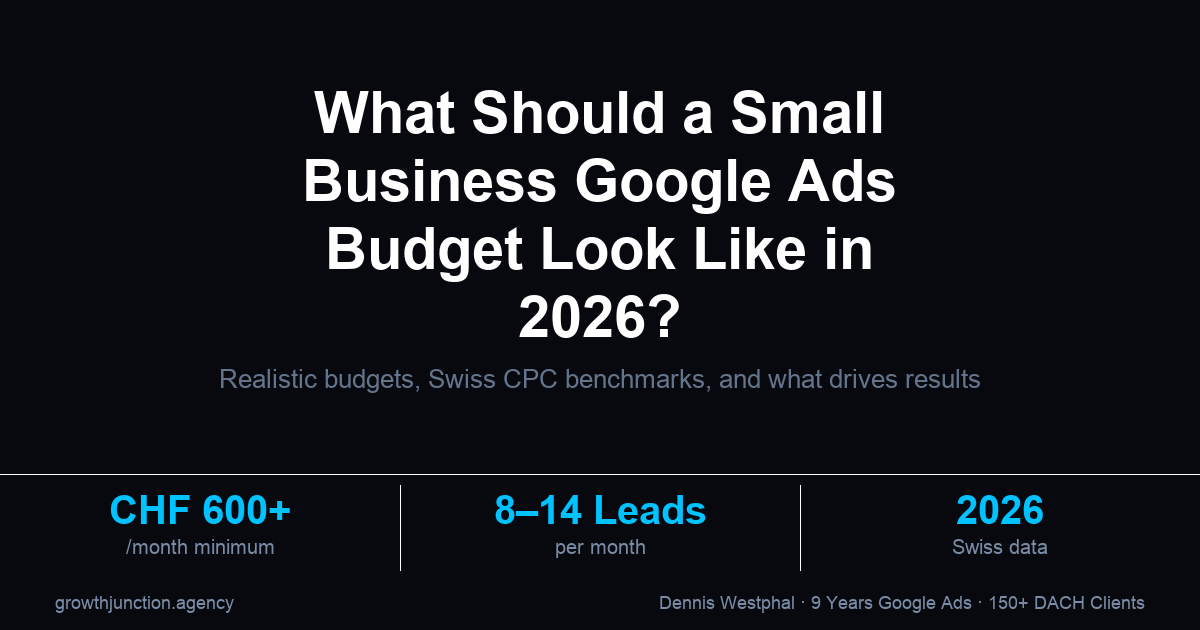
- The realistic minimum budget for a Swiss service SMB is CHF 1,000/month in ad spend - preferably more. Below that, the algorithm cannot accumulate enough conversion data to optimise effectively.
- Average CPCs in Switzerland range from CHF 0.50-1.50 (restaurants/food) to CHF 9-25+ (moving/competitive service niches) - industry determines your budget more than anything else.
- At CHF 1,000/month, a well-run campaign typically generates 8-14 enquiries/month for a Swiss service business with a functional landing page.
A realistic Google Ads budget for a small service business in Switzerland usually starts at CHF 1,000 per month in ad spend. Below that level, most accounts do not gather enough conversion data for reliable optimisation. In the live benchmark set, Swiss CPCs ranged from roughly CHF 0.50 in lower-cost categories up to CHF 25 or more in competitive service niches such as moving or healthcare (DataForSEO, March 2026). The right budget depends mostly on your industry economics, not on what feels comfortable to spend.
What does a realistic Google Ads budget look like for a small business?
The most common question I get from Swiss SMB owners is simple: how much do I actually need to spend? The honest answer depends on three things, your average CPC, your target geography, and how fast you need the account to produce usable data. In practice, the biggest mistake is not underestimating ambition. It is underestimating how much data the account needs before decisions stop being guesswork.
Here is a practical budget framework based on what I see across DACH accounts. Treat it as a planning model, not a promise.
| Monthly Budget | Gets you | Best For | Est. Leads/mo |
|---|---|---|---|
| CHF 300-500 | 50-100 clicks/mo (low-CPC industries only) | Restaurants, retail - testing phase only | 2-5 (inconsistent) |
| CHF 1,000-1,200 | 80-150 clicks/mo (varies heavily by industry CPC) | Minimum viable for most service sectors | 4-10 |
| CHF 1,000-1,500 | 250-500 clicks/mo, enough data to optimise | Most service SMBs - recommended start | 10-22 |
| CHF 2,000-3,000 | 500-900 clicks/mo, smart bidding fully active | Professional services, competitive trades | 20-40 |
| CHF 3,500+ | Full market coverage for most Swiss cities | Scaling - multi-service or multi-location | 35-60+ |
These lead estimates assume a landing page with a 5-7% conversion rate and conversion tracking working correctly (see our GA4 conversion tracking guide). If either is missing, your actual CPA will be significantly higher.
How much does a click actually cost in Switzerland?
Swiss CPCs are often 30 to 80 percent higher than comparable queries in Germany, with some sectors sitting above that range in live pulls (DataForSEO, March 2026). The usual reasons are straightforward: higher customer value, a smaller total search pool, and more competition compressed into a smaller geographic market.
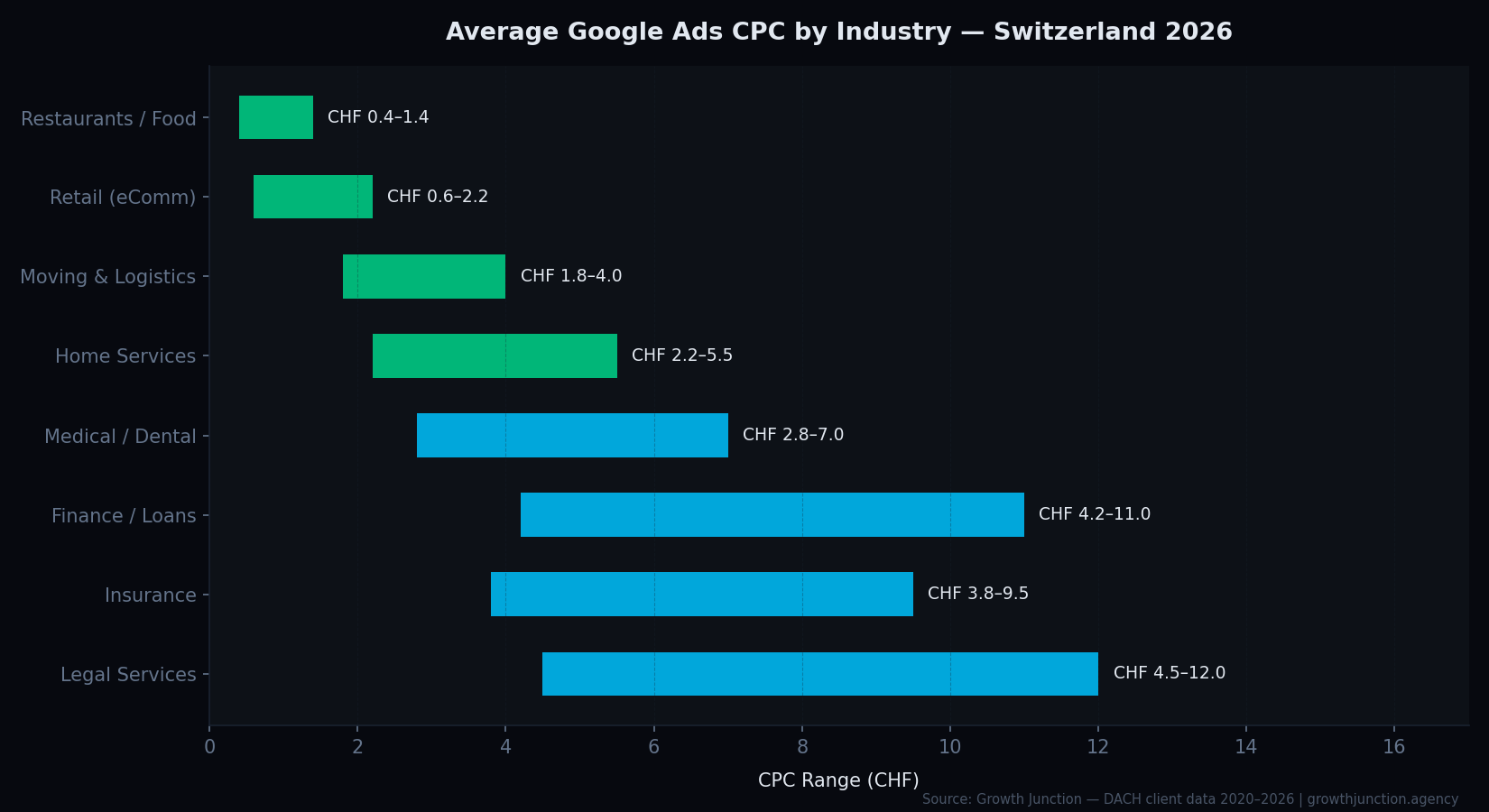
Average CPC ranges by industry in Switzerland - data from DACH client accounts managed by Dennis Westphal at Growth Junction, 2020-2026.
The most important takeaway from this dataset is simple: your industry determines your budget more than your ambition does. That is why broad advice like "start with CHF 500" is usually useless. A restaurant, a moving company, and a legal practice do not buy the same market access for the same money. For the wider CPC context, see the full Switzerland benchmark breakdown.
- Restaurants / food: CHF 0.50-1.50
- Cleaning / trade services: CHF 1.50-4.00
- Real estate (buyer keywords): CHF 0.40-2.50
- Legal services: CHF 3.00-7.00
- Financial / insurance: CHF 6.00-10.00
- Moving companies: CHF 9.00-25.00
- IT / SaaS: CHF 10.00-15.00
- Dental / healthcare: CHF 5.00-25.00+
Two additional factors push Swiss CPCs up: location targeting and device. Campaigns targeted at Zürich or Geneva typically run 15-25% higher CPCs than campaigns covering smaller cities like Bern, Basel, or Winterthur - simply because there is more competition. Mobile CPCs are typically 20-30% lower than desktop for service businesses, but desktop tends to convert at higher rates for B2B queries.
How much budget do you need to generate leads, not just clicks?
The critical threshold is not clicks. It is conversions. In practice, Search campaigns can start learning with lower volume, but they become more reliable once they consistently produce around 15 to 30 conversions per month. That is the point where bid decisions usually stop swinging so wildly. If the account sits far below that level, it may still work, but optimisation becomes slower and less stable.
Work backwards from that threshold. If your landing page converts at 6 percent and your average CPC sits at CHF 3.50, then 250 to 500 clicks produce roughly 15 to 30 conversions. At CHF 3.50 per click, that implies a budget of about CHF 875 to 1,750 per month. That is why CHF 1,000 is a realistic floor for many Swiss service accounts, not an arbitrary round number.
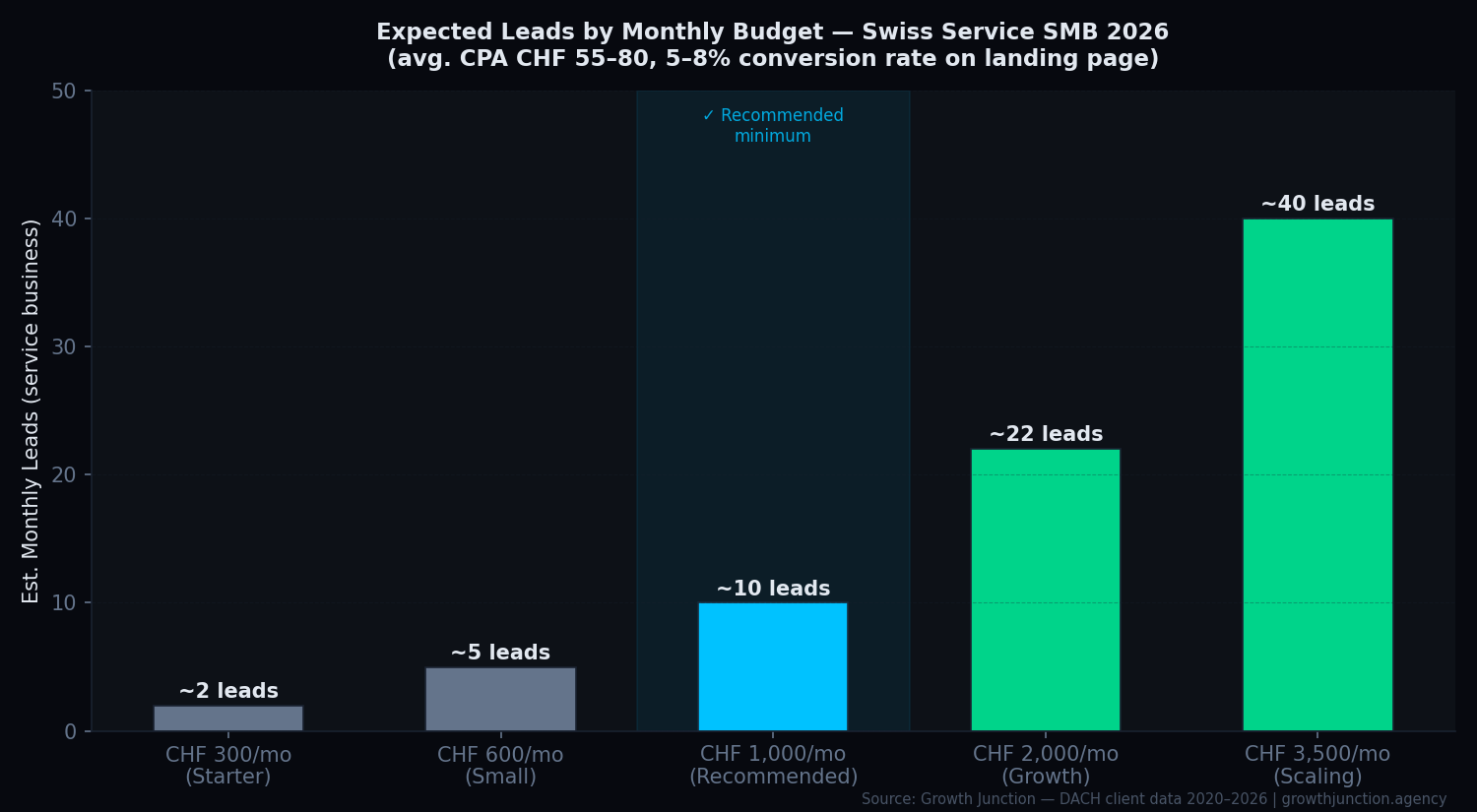
Estimated monthly leads by budget level for Swiss service-based small businesses. Assumes 5-7% landing page conversion rate and average CPA of CHF 55-80. Figures are estimates based on managed DACH accounts, not guarantees.
For most Swiss service businesses, the practical minimum to generate consistent, optimisable lead volume is CHF 1,000/month. Below that, you can still generate leads, but expect more volatility and a longer time to stable performance.
Should you start small or go bigger from day one?
Starting at 70-80% of your intended budget from day one beats ramping up slowly. Every time you make a significant budget increase (more than 20-30% in a short period), Google's algorithm enters a new learning phase and performance typically dips for 1-2 weeks. If you spend six months ramping up from CHF 200 to CHF 1,000, you essentially reset the learning phase multiple times.
The exception is when you are genuinely uncertain about your market fit. In that case, start with a small test budget on a single tightly focused campaign for 4-6 weeks - just to validate that searches exist and people click. But treat that as a research phase, not a performance phase. Once you have confirmed demand, commit to the full budget and give the algorithm time to learn.
A practical framing: if you would not invest CHF 1,000/month for 90 days to find out whether Google Ads works for your business, it probably means you are not confident enough in the underlying offer. The channel rarely fails when the offer is right, the tracking works, and the landing page is relevant. It almost always "fails" when one of those three elements is broken.
How should you split your budget across campaign types?
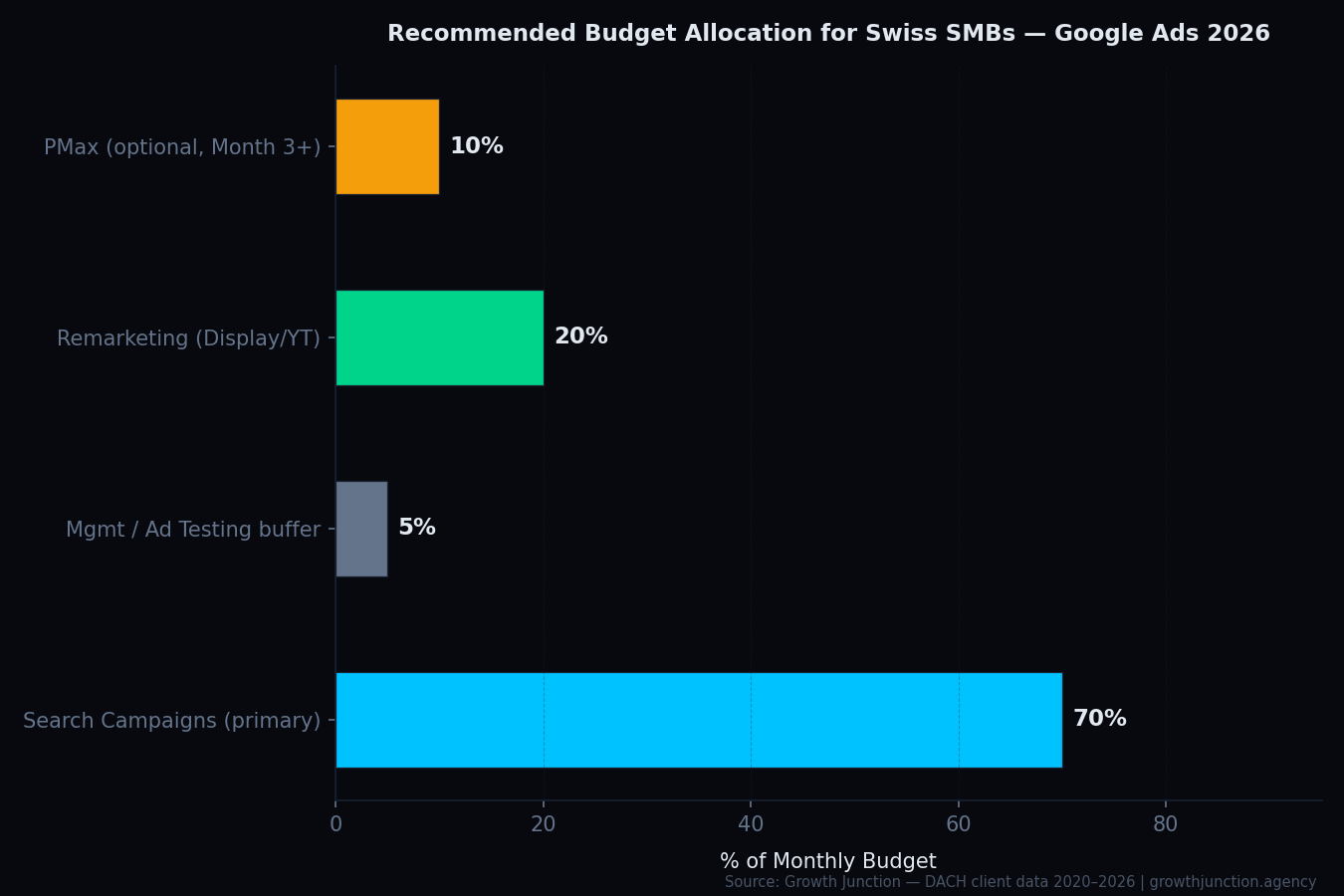
Recommended budget allocation framework for Swiss service SMBs starting with Google Ads in 2026. Adjust percentages based on your industry's search volume and funnel length.
For most small businesses starting with Google Ads, I recommend allocating approximately:
- 70% to Search campaigns - this is your primary demand capture channel. People searching for what you sell, right now.
- 20% to Remarketing (Display or YouTube) - re-engage website visitors who did not convert. Works well for higher-ticket services with a longer decision cycle.
- 10% to Performance Max experiments - only after month 3, once you have conversion data. Not before.
Do not start with Performance Max as your primary campaign. It requires conversion history to work well, and it gives you very limited control and visibility in the early stages. Start with Search, build conversion data, then layer in PMax once the algorithm has something to learn from.
For budgets under CHF 1,000/month, skip remarketing entirely and put 100% into a tightly focused Search campaign. The remarketing audience will be too small to be effective at low spend levels anyway.
A real example: what a well-run Zürich-area campaign looks like
One of the clearest examples from client work comes from the moving category around Zürich. I use this niche a lot when explaining budget because the economics are brutally visible. Clicks are expensive, quote rates are measurable, and weak setup shows up fast.
Moving is one of the most competitive Google Ads niches in Switzerland. Around Zürich, moving keywords regularly sit in the CHF 9 to 25 range per click in benchmark pulls. That means CHF 1,000 per month buys enough traffic to learn, but not enough to dominate the market. In practice, that budget is often a testing and stabilisation budget, not a scaling budget.
The actual lesson is broader than moving. Every niche has a minimum viable budget below which the data signal is too weak for optimisation. For moving in Zürich, that floor is clearly higher than it is for a lower-CPC service in a smaller market. For a local cleaning business outside the most expensive cities, CHF 1,000 per month can already be workable. For moving, it often is not.
That is why I do not like generic advice on Google Ads budgets. Budget only makes sense when it is tied to CPC, conversion rate, and job value. If one of those three is missing, the planning is guesswork. If all three are understood, the budget conversation becomes much easier to ground in reality.
Data sources
Benchmark data and market observations from Google Ads accounts managed by Dennis Westphal across Switzerland and the DACH region (2020-2026). Keyword volume data: DataForSEO March 2026. Industry context based on official Google Ads documentation.
Not sure what budget makes sense for your business?
Start with the free Lead-Leak Analysis. I will look at the assumptions behind your market, budget and current setup, then identify the first leak worth investigating. No generic pitch and no obligation.
Frequently asked questions
What is the minimum budget for Google Ads in Switzerland?
The realistic minimum for a service-based small business in Switzerland is CHF 1,000 per month in ad spend - preferably more. Below that threshold, most campaigns do not accumulate enough conversion data for Google's smart bidding to work effectively. For competitive sectors like legal services, dental, IT, sauna manufacturing, or financial services, CHF 1,500-2,500/month is more appropriate to generate consistent lead volume. Retail and e-commerce can sometimes start slightly lower because CPCs are lower, but expect a longer ramp-up. CHF 1,000/month is the floor, not the target.
How much budget should I plan for Google Ads as a Swiss small business?
At CHF 300/month, you are getting approximately 50-100 clicks per month depending on your industry CPC. That is rarely enough to generate consistent leads or give Google's algorithm enough data to optimise. In competitive service industries (trades, legal, medical), CHF 300/month will produce erratic results. If budget is genuinely constrained to CHF 300/month, the best approach is to run a tightly focused single campaign on your highest-intent keywords only, use exact match or tightly controlled phrase match, and accept that it is a learning phase rather than a revenue driver.
What is a good cost per lead for Google Ads in Switzerland?
Cost per lead varies dramatically by industry. For plumbers and electricians in Switzerland, a realistic CPA is CHF 35-90 per enquiry. For professional services (accountants, lawyers, consultants), expect CHF 80-200 per qualified lead. Home services (plumbers, electricians, cleaners) typically run CHF 35-90 per lead. Medical and dental practices see CHF 60-150 per new patient enquiry. These figures assume a functional landing page with at least a 4-6% conversion rate. If conversion tracking is broken or the landing page is poor, effective CPA can be 3-5x higher even with the same ad spend.
Should you increase your Google Ads budget gradually or start with the full amount?
Starting with 70-80% of your intended budget is generally better than ramping up slowly from very small amounts. Here is why: Google's smart bidding needs conversion data to set bids accurately. If you start at CHF 200/month and ramp to CHF 1,000/month over six months, you essentially restart the learning period each time you make a significant budget change. A better approach is to start at your target budget, run for 60-90 days to establish a performance baseline, and then optimise from there. If budget is genuinely limited early on, use that smaller budget on a single focused campaign rather than spreading across multiple campaigns.
Does a higher Google Ads budget always produce proportionally more leads?
Not always - and this is an important nuance. Doubling your budget from CHF 1,000 to CHF 2,000/month often produces more than double the leads initially, because the algorithm has more data and can target more efficiently. But there is a ceiling in every market defined by search volume. Once you have captured most of the relevant search queries in your area, additional budget produces diminishing returns. For most Swiss SMBs in non-major cities, that ceiling is somewhere between CHF 2,000-4,000/month for a single service line. Beyond that, you need to expand geographically, add new services, or explore other channels.
Do Google Ads management fees count towards the budget?
No - Google Ads management fees are separate from the ad spend budget. When people talk about a "Google Ads budget" in business planning, they mean the amount paid directly to Google for clicks. A freelancer or agency fee is charged on top of that. At Growth Junction, the management fee covers campaign setup, ongoing optimisation, reporting, and conversion tracking - the ad spend goes entirely to Google. The total monthly investment for a managed account therefore includes both: for example, $1,000/month ad spend plus the management fee. This distinction matters when comparing freelancers, agencies, and self-managing.
Is $100 enough for Google Ads?
$100 per month is not enough for meaningful Google Ads results for most service businesses. At typical service-industry CPCs of $3-15 per click, $100 buys you 7-33 clicks per month - not enough data for the algorithm to learn or to generate consistent leads. The realistic minimum for a service-based small business is $1,000/month in ad spend. Below that, most campaigns cannot accumulate enough conversion data for smart bidding to optimise effectively. If $100/month is your budget, Google Ads is not the right channel yet.
Is $20 a day good for Google Ads?
$20 a day ($600/month) sits below the threshold for reliable results in most service industries. At average service CPCs of $3-15, you are looking at 40-200 clicks per month - often not enough for smart bidding to exit learning mode, which requires 15-30 conversions per month. For low-CPC industries like restaurants or retail, $20/day can produce some results. For professional services, trades, or any competitive niche, you will see erratic performance until you reach at least $30-35/day ($1,000/month).
Ready for a clearer diagnosis?
The free Lead-Leak Analysis connects search intent, campaign structure, landing pages, measurement and sales feedback around your account. Use the Google Ads leak-score quiz first, or complete the two-question fit check—no generic pitch and no obligation to rebuild everything.
The fit check takes less than a minute.Use USD or your local equivalent. Your answers stay in your browser and only determine whether the booking calendar appears.
Turn this insight into a clearer next decision.
Best Google Ads Agency Switzerland Small Business
Related Growth Junction guide.
Read the guide →02 · Related guideGoogle Ads Audit Checklist
Related Growth Junction guide.
Read the guide →03 · Related guideConversion Tracking Audit
Related Growth Junction guide.
Read the guide →Service bridgeGoogle Ads
Fix the demand-to-qualified-lead route.
Explore the service ↗