
Swiss Google Ads Benchmarks 2026: CPC, CTR and ROAS by Industry
Swiss Google Ads benchmarks for 2026: realistic CPC, CTR, conversion rate, ROAS and monthly budget ranges by industry - based on real DACH market experience, not generic US averages.

TL;DR
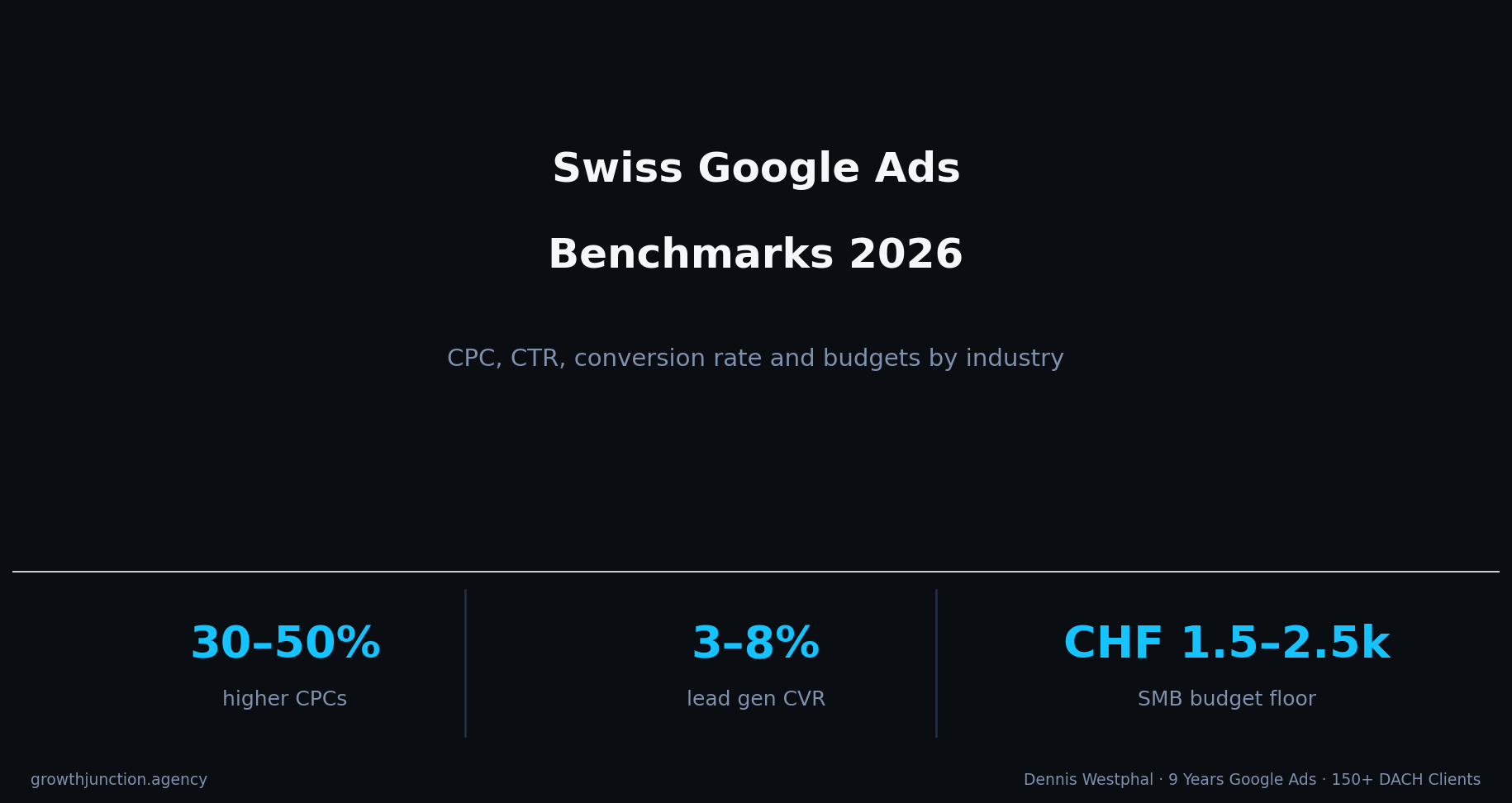
- Swiss Google Ads clicks are usually 30-50% more expensive than in comparable German markets.
- A well-run lead gen campaign in Switzerland should usually land in the 3-8% conversion rate range, with local services often higher.
- Most Swiss SMBs need at least CHF 1,500-2,500/month to generate enough data for reliable optimisation.
What are good Google Ads benchmarks in Switzerland?
If you benchmark Google Ads performance against US or broad European averages, you are comparing yourself against the wrong market. Switzerland is smaller, usually more expensive, more competitive per auction, and less forgiving when the landing page is weak (CPC factors explained by Google). Use these benchmarks alongside our Swiss SMB budget guide and Quality Score explainer.
In practical terms, that means three things. First, CPCs are higher than most small businesses expect. Second, conversion tracking matters more, because smaller markets give you less data and less room for wasted spend. Third, budget discipline matters: underfunded campaigns often never collect enough signal for smart bidding to work properly. The Swiss market punishes vague setup faster than bigger markets do because there is less slack in the system. Weak accounts get exposed sooner here.
These benchmarks are based on real account patterns across Switzerland and the broader DACH market, not scraped "global averages" that mix e-commerce, lead gen, brand traffic, and junk data into one meaningless number (Growth Junction account review set, 2020-2026; WordStream benchmark context, 2025).
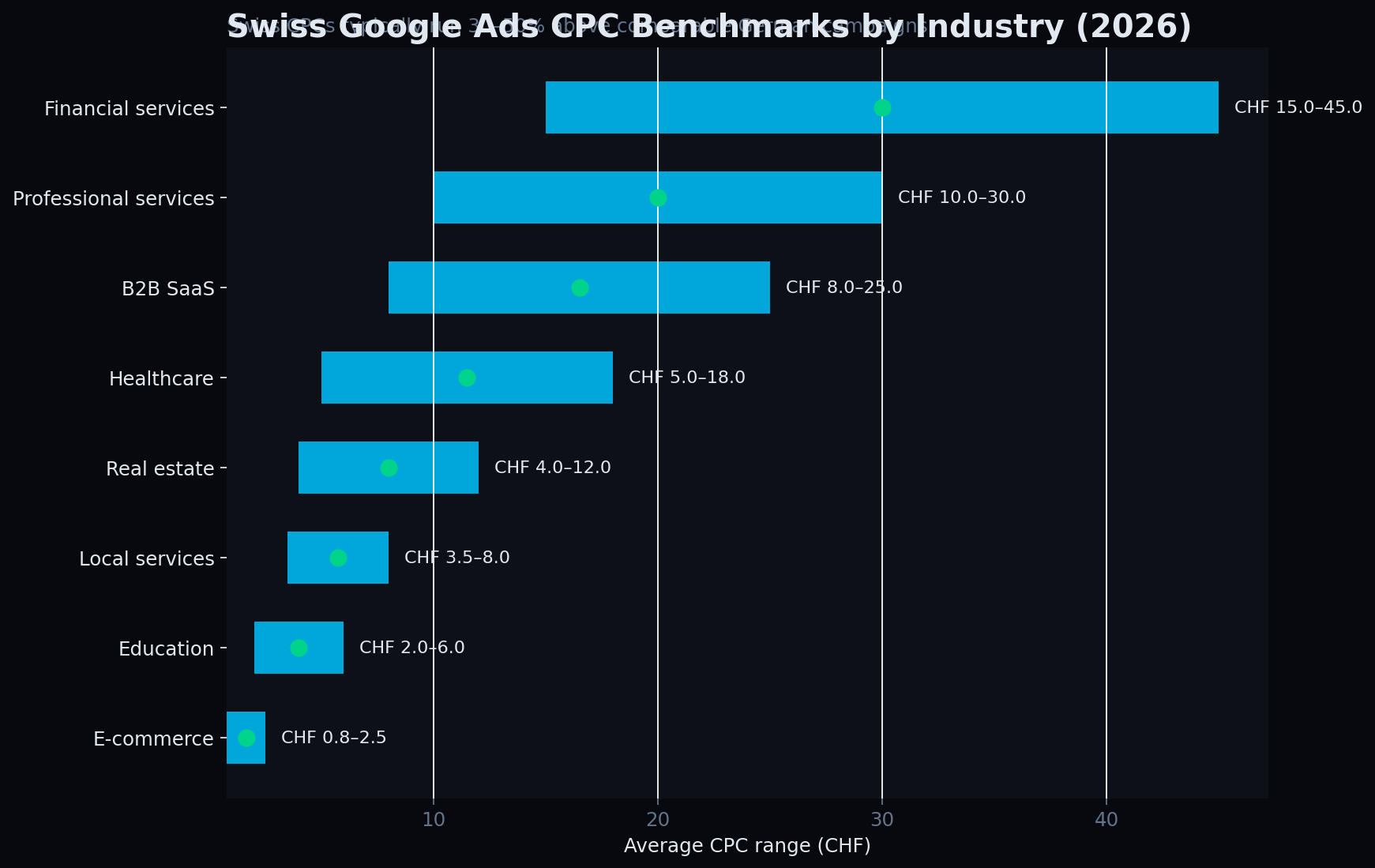
Swiss CPCs are highest in financial and professional services, while ecommerce stays lower unless the search terms are extremely competitive.
What is a good CPC in Switzerland?
A "good" CPC is not simply a low CPC. A CHF 14 click that produces qualified enquiries can be far better than a CHF 1.80 click from vague, low-intent traffic. The right question is whether the click cost is justified by the intent and the expected customer value. That is the pricing lens I use in audits. Cheap traffic is often the most expensive traffic once lead quality enters the picture.
For Switzerland in 2026, these are realistic search CPC ranges in CHF:
| Industry | CPC range | Notes |
|---|---|---|
| Financial services | CHF 15-45 | Highest competition, highest customer value |
| Professional services | CHF 10-30 | Law, consulting, specialist services |
| B2B SaaS | CHF 8-25 | Long sales cycle, weak tracking ruins bidding |
| Healthcare | CHF 5-18 | Regulated and locally competitive |
| Real estate | CHF 4-12 | Intent strong, seasonality matters |
| Local services | CHF 3.5-8 | Often the best small-business economics |
| Education | CHF 2-6 | Longer decision cycle, lower urgency |
| E-commerce | CHF 0.8-2.5 | Lower on Shopping, higher on high-intent Search |
As a rule of thumb, Swiss CPCs tend to run 30-50% above comparable German campaigns. That is normal. It does not mean the account is broken. It means the market is smaller, bids are tighter and advertisers can often afford to pay more per qualified click.
What is a good CTR in Switzerland?
CTR only makes sense in context. A 2% CTR on branded search is weak. A 2% CTR on a cold B2B search campaign can be perfectly fine. What matters is whether the ad is attracting the right clicks - not just lots of clicks.
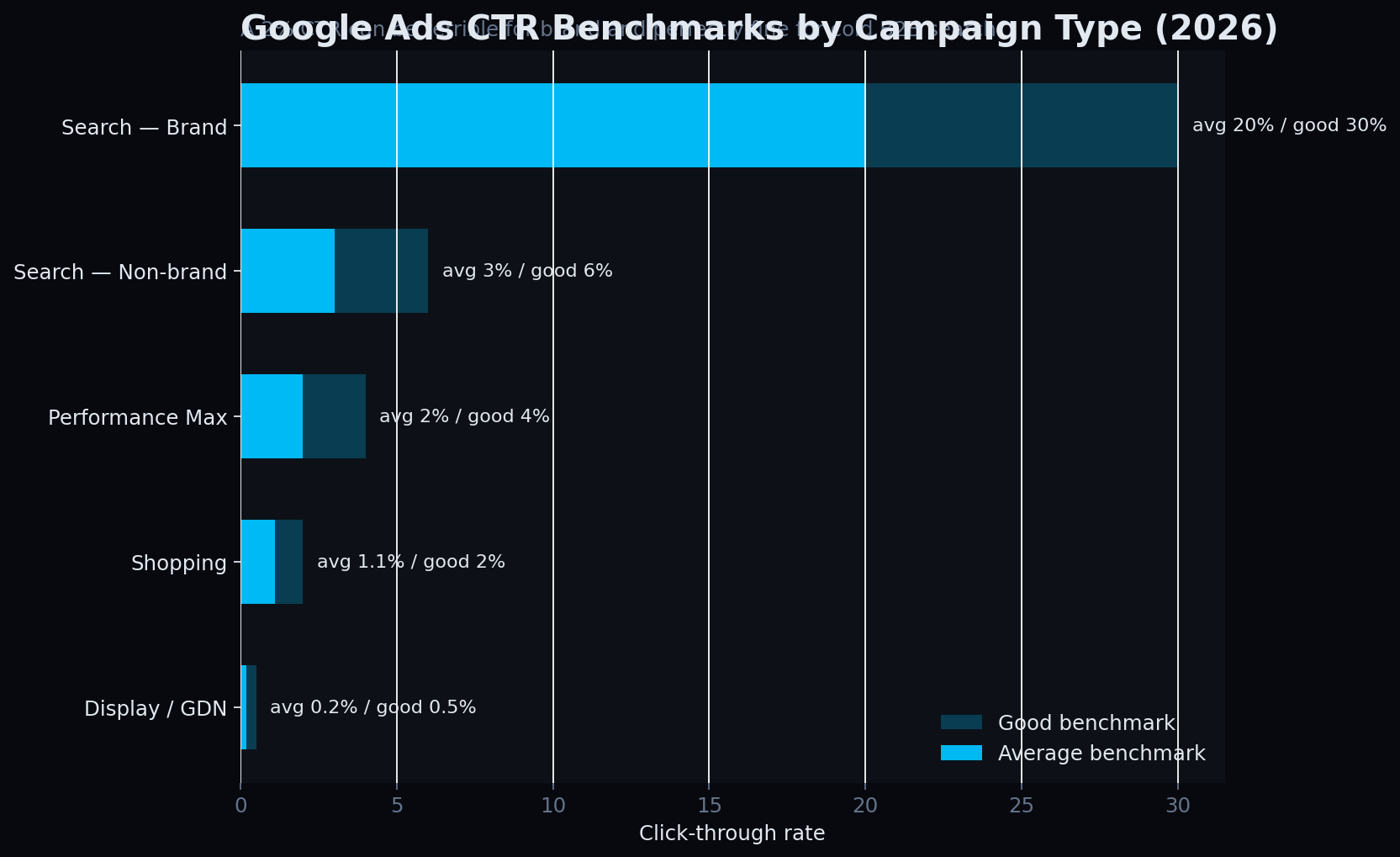
CTR benchmarks vary massively by campaign type. Brand search and non-brand search should never be judged by the same standard.
Useful Swiss CTR benchmarks for 2026:
| Campaign | Average | Good |
|---|---|---|
| Search - Brand | 15-25% | 30%+ |
| Search - Non-brand | 2-4% | 5-8% |
| Performance Max | 1-3% | 4%+ |
| Shopping | 0.5-1.5% | 2%+ |
| Display / GDN | 0.1-0.3% | 0.5%+ |
In practice, low non-brand CTR is usually a copy problem before it is a bidding problem. One of the fastest improvements you can make is to stop writing generic service headlines and lead with a more concrete outcome or differentiator.
What is a good conversion rate in Switzerland?
This is where most accounts go wrong. People see "industry averages" online and assume the campaign is underperforming. In reality, the campaign may be fine and the landing page is what is dragging everything down.
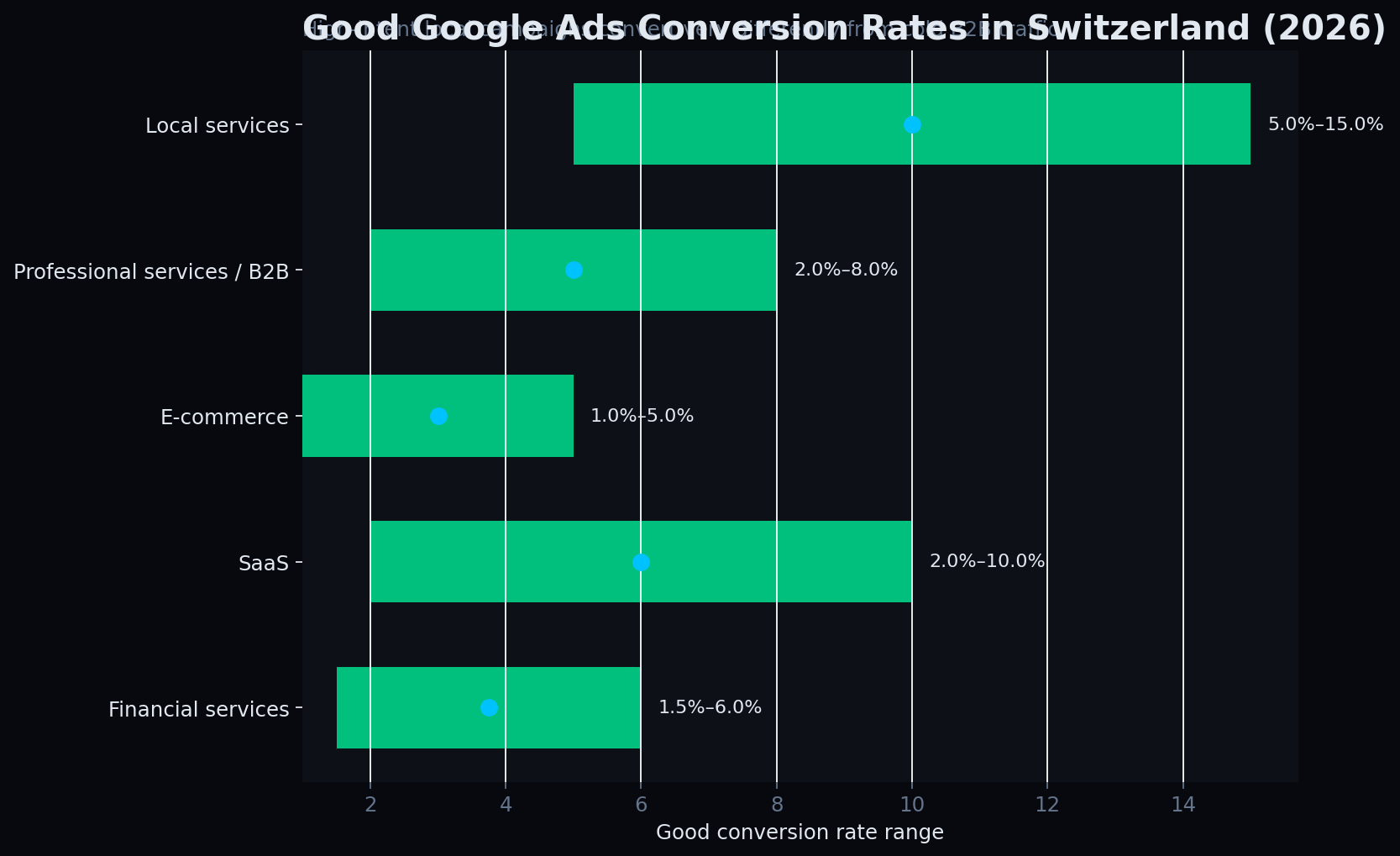
High-intent local search traffic usually converts far better than colder B2B traffic. That is expected.
| Business | Weak | Good |
|---|---|---|
| Local services | < 3% | 5-15% |
| Professional services / B2B | < 1% | 2-8% |
| E-commerce | < 0.5% | 1-5% |
| SaaS | < 1% | 2-10% |
| Financial services | < 1% | 1.5-6% |
In my experience working with clients in the DACH market, conversion issues are usually a landing page problem, not an ad problem. A Swiss sauna manufacturer can easily get decent click volume and still convert badly if the page asks for too much, looks generic or gives no trust signal.
If you are getting clicks from high-intent terms but sitting below 2% conversion rate, look at the page first: message match, form friction, proof, mobile UX and speed. Most of the time, that is where the money is leaking.
What budget do Swiss SMBs actually need?
Most businesses do not have a Google Ads problem. They have a data volume problem. They set a budget that is enough to buy some clicks but not enough to generate a reliable learning signal. Standard Search campaigns can often start learning from around 10 conversions in 30 days, while Performance Max usually needs far more data before it becomes trustworthy.
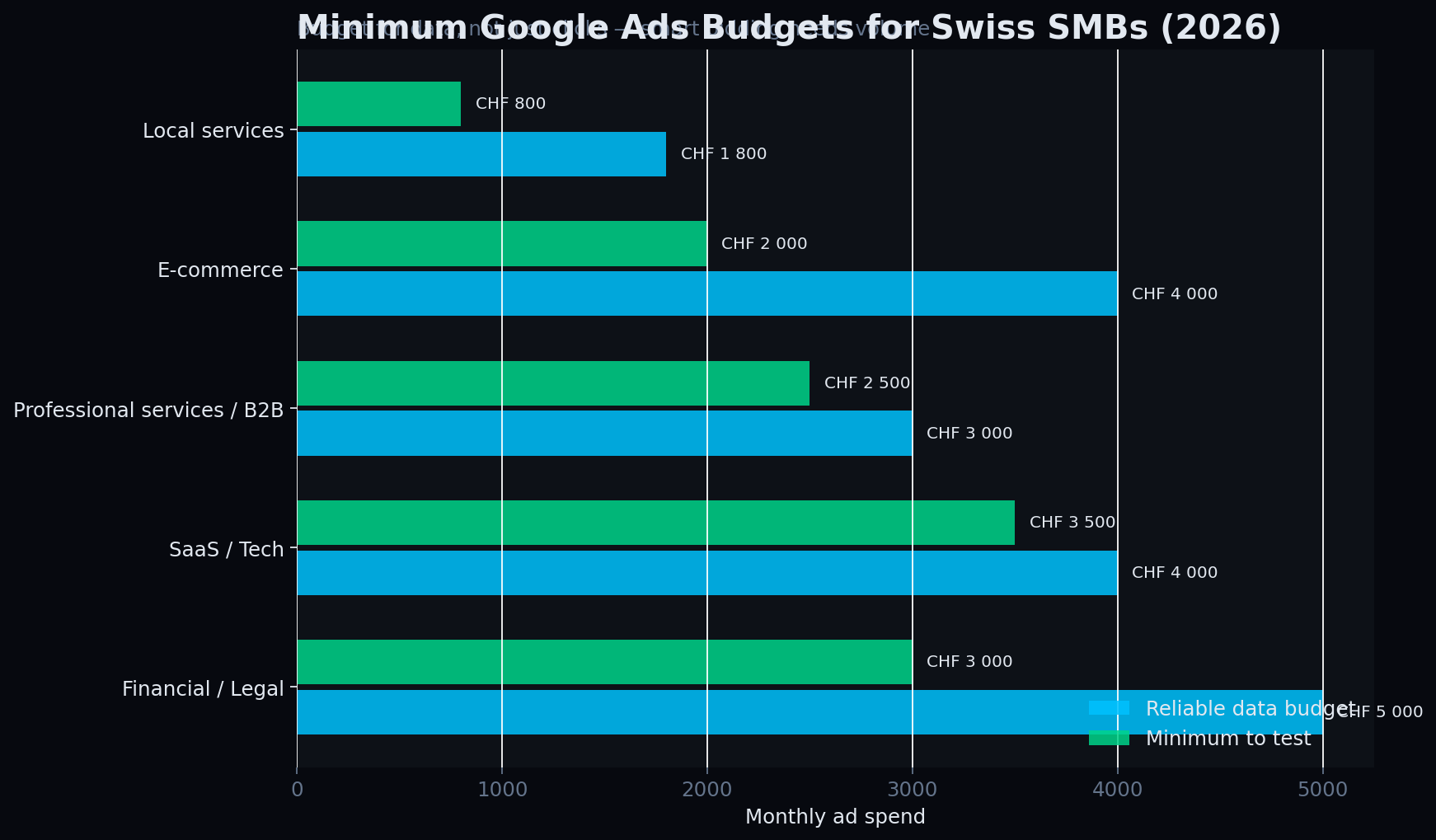
The minimum testing budget and the budget required for reliable data are not the same thing. Underfunded campaigns often never stabilise.
| Business | Min. to test | Min. reliable |
|---|---|---|
| Local services | CHF 500-800 | CHF 1,200-1,800 |
| E-commerce | CHF 1,000-2,000 | CHF 2,500-4,000 |
| Professional services / B2B | CHF 1,500-2,500 | CHF 3,000+ |
| SaaS / Tech | CHF 2,000-3,500 | CHF 4,000+ |
| Financial / Legal | CHF 3,000+ | CHF 5,000+ |
If the budget is too thin, the account never exits learning mode properly. That is why "Google Ads did not work" is often just another way of saying "the campaign never had enough conversion volume to be judged fairly." I see this constantly in small business accounts that were asked to produce stable results on a testing budget.
Should a Swiss SMB start with Search or Performance Max?
For most new Swiss accounts, the answer is simple: start with Search. Search gives you tighter control over intent, queries, budget allocation and messaging. That matters a lot when every click is expensive and data is limited.
Search is usually better when:
- the account is new and conversion volume is still low
- query control matters because the service is specific or expensive
- tracking is still being validated
- the business needs lead quality, not just volume
Performance Max becomes more useful when:
- you already have 30+ monthly conversions
- tracking is clean
- creative assets exist
- Search has already proven the offer works
That sequence matters. Running Performance Max too early is one of the easiest ways to waste budget in a small market.
How to use these benchmarks without misreading your account
Benchmarks are a context tool, not a verdict. I use them to ask better questions, not to declare an account good or bad in isolation. A high CPC can still be healthy if lead quality is strong. A strong CTR can still be useless if the landing page leaks intent. A weak conversion rate can still point to tracking before it points to the campaign.
The right use is simple: compare your account against the relevant business type, then check whether the rest of the system supports the number you are looking at. If your CPC is normal but your conversion rate is weak, the page is usually the first place to look. If your CPC is high and your CTR is low, ad relevance and Quality Score usually matter more than budget. If your spend is low and conversions are sporadic, the issue is often volume, not performance. That is how I use benchmarks in audits, as a directional filter rather than a one-number judgment.
Data sources & methodology
CPC, CTR, conversion rate and budget ranges reflect patterns from Swiss and DACH Google Ads accounts managed by Dennis Westphal between 2020 and 2026 across local services, B2B, e-commerce, SaaS and professional services. Keyword search volume data sourced from DataForSEO (March 2026). Industry benchmark ranges cross-referenced against WordStream 2025 Google Ads Industry Benchmarks and Google Ads Help Centre documentation. Swiss-specific premiums reflect direct market observations; no single published dataset covers Switzerland in isolation.
Need a second pair of eyes?
If your numbers are below these benchmarks, that does not automatically mean Google Ads is the wrong channel. It usually means something specific is off. Start the free Lead-Leak Analysis to identify the first account or journey break worth investigating.
Frequently asked questions
What is the average CPC for Google Ads in Switzerland?
It depends heavily on the industry. Local services often sit around CHF 3.50-8.00 per click, professional services around CHF 10-30, and financial services can reach CHF 15-45. Swiss CPCs are usually 30-50% higher than comparable German campaigns.
What is a good conversion rate for Google Ads in Switzerland?
For high-intent local services, 8-15% is a strong benchmark. For B2B and professional services, 3-6% is already solid. If you are below 2% on high-intent keywords, the landing page is usually the issue.
How much should a Swiss small business spend on Google Ads?
For local services, CHF 1,000-2,000 per month is a sensible starting range. Professional services, B2B and SaaS often need CHF 2,500-4,000+ to generate enough conversion data for reliable optimisation.
Is ROAS the right benchmark for lead generation?
Usually no. ROAS is best for e-commerce. For lead generation, cost per qualified lead and close rate are more useful than trying to force a ROAS model onto a long sales cycle.
Is Performance Max a good starting point for a new Swiss account?
Usually not. New accounts should start with Search unless they already have enough conversion data and creative assets. Performance Max tends to waste budget when there is not enough historical signal to optimise against.
Should I benchmark Swiss Google Ads against German or US averages?
No. Swiss auctions are usually more expensive and the market is smaller, so broad US or even Germany-wide averages distort planning. Use Swiss-specific benchmarks wherever possible, then compare against your own account history.
Ready for a clearer diagnosis?
The free Lead-Leak Analysis connects search intent, campaign structure, landing pages, measurement and sales feedback around your account. Use the Google Ads leak-score quiz first, or complete the two-question fit check—no generic pitch and no obligation to rebuild everything.
The fit check takes less than a minute.Use USD or your local equivalent. Your answers stay in your browser and only determine whether the booking calendar appears.
Turn this insight into a clearer next decision.
Best Google Ads Agency Switzerland Small Business
Related Growth Junction guide.
Read the guide →02 · Related guideGoogle Ads Audit Checklist
Related Growth Junction guide.
Read the guide →03 · Related guideConversion Tracking Audit
Related Growth Junction guide.
Read the guide →Service bridgeGoogle Ads
Fix the demand-to-qualified-lead route.
Explore the service ↗