
Google Ads Performance Max: Should Small Businesses in Switzerland Use It?
Performance Max sounds efficient at first glance. One campaign. Every Google channel. Heavy automation. For most Swiss small businesses with limited budgets and low conversion volume, Standard Search still does a better job. This guide shows where PMax fits and where it usually goes wrong.

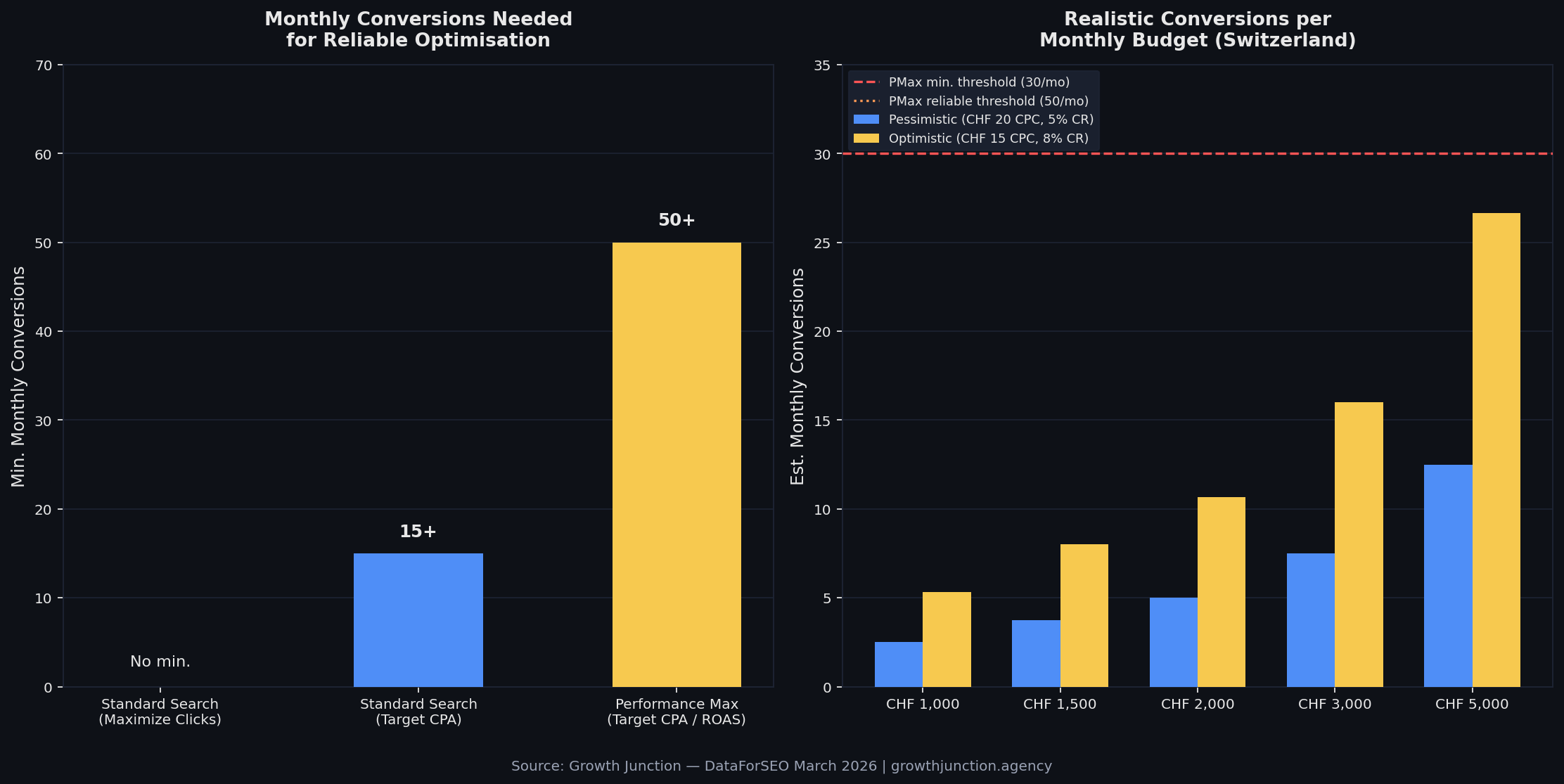
In short
- Performance Max works best for e-commerce accounts with product feeds and accounts producing 50 or more conversions per month.
- Most Swiss service SMBs spending CHF 1,000 to 2,000 per month do not generate enough conversion volume for PMax to learn well.
- PMax can cannibalise branded search traffic if brand exclusions are missing.
- Standard Search gives you keyword-level control, which matters when data is thin and budget mistakes hurt fast.
Performance Max is Google's most automated campaign type. One campaign can run across Search, Display, YouTube, Gmail, Maps, and Discover. That sounds attractive. In practice, most Swiss small businesses do better with Standard Search first. The reason is simple. PMax needs solid conversion volume. Most smaller Swiss accounts do not have it.
This guide shows what Performance Max actually does, where it fits, and why the Swiss cost structure changes the decision. My blunt view: for most Swiss service businesses, PMax is not the smart default. It is the thing you test after the basics are already proven. If you want the broader setup behind this choice, see our Google Ads budget guide for small businesses.
What is Performance Max?
Performance Max, often shortened to PMax, is a goal-based Google Ads campaign type. You provide creative assets, conversion goals, budget, and optional audience signals. Google then decides where ads run, which asset combinations appear, and how bids are adjusted.
- Assets: headlines, descriptions, images, logos, and video if available
- Goals: calls, leads, purchases, or other tracked actions
- Signals: budget, geography, and audience hints
That setup can work well when the account already has clean data and enough conversion history. Without that base, automation tends to spread budget before it proves where the real value sits.
How Performance Max works
PMax relies on Smart Bidding. Bids are adjusted auction by auction based on signals like device, location, time of day, query context, and past conversion behaviour.
The important constraint is data volume. In real account work, Search can start learning with lower volume, but Performance Max usually needs roughly 30 to 50 conversions per month before the signal becomes dependable enough to trust at scale (Google Ads Smart Bidding documentation, April 2026; DataForSEO market context, April 2026). Because PMax spreads across more inventory with less direct control, weak signal hurts faster.
If that signal is missing, the system is not really learning your business. It is spending money while trying to figure it out.
Performance Max vs Standard Search: the honest comparison
Standard Search gives you direct control. You decide which keywords matter, which match types to use, which ads show, and which landing page receives the click. When performance drops, you can trace the problem quickly.
PMax removes a lot of that control. If too much spend shifts into Display or YouTube, you cannot just switch those channels off one by one. Google has improved reporting, but you still do not get the same keyword-level visibility that Search gives you.
I also see Google reps and automated recommendations push PMax regularly. That is not surprising. PMax helps Google use more of its inventory. Sometimes that is useful. Sometimes it just means more places to waste budget if the account is not ready.
| Factor | Standard Search | Performance Max |
|---|---|---|
| Keyword control | Full control over keyword targeting | Google decides which queries to match |
| Channel control | Mainly Search, with optional network settings | Runs across multiple Google channels with limited control |
| Conversion volume needed | Often workable from 15 to 30 conversions per month | Usually stronger once the account reaches 50 or more conversions per month |
| Transparency | Strong reporting at keyword, device, and location level | Partial reporting, but still less clear than Search |
| Best fit | Service businesses, new accounts, lower data volume | E-commerce, Shopping, and mature accounts with strong signal |
That gap in transparency matters even more when the budget is tight. With Standard Search, you can see where the spend goes. With PMax, diagnosis gets slower just when you need it to be sharper. For a small business, slower diagnosis means more wasted budget before anyone knows what actually failed.
When Performance Max actually works
Performance Max can work very well in the right setup:
- E-commerce with product feeds. That feed gives Google rich input and Shopping placements add strong purchase intent.
- Accounts with stable conversion volume. Once the account generates 50 or more conversions per month consistently, PMax has something real to learn from.
- Accounts with strong creative coverage. Good assets make a bigger difference when the system is mixing formats across multiple placements.
When Performance Max fails small businesses
For many Swiss service businesses, PMax creates more friction than upside:
- Too little conversion volume. A CHF 1,000 to 1,500 monthly budget often produces 5 to 15 conversions, not enough for stable learning.
- Branded traffic cannibalisation. Without brand exclusions, PMax can take credit for demand that already existed.
- Weak negative control. Search lets you steer traffic far more tightly.
- Limited visibility. You can see more than before, but you still cannot diagnose performance as cleanly as in Search.
The Swiss context: budget, CPCs, and conversion thresholds
Swiss CPCs are often materially higher than comparable German keywords. In our April 2026 DataForSEO comparison, several Swiss keywords came in roughly 30 to 80 percent above comparable German terms (DataForSEO, April 2026). That matters because the same budget buys less data.
Take the benchmark keyword Google Ads Kampagne. In Switzerland, the CPC sat at CHF 19.55 in the live pull. A CHF 1,000 monthly budget at that price buys roughly 50 clicks, not 50 conversions. Even with a decent landing page, the conversion volume stays low fast.
That is why I do not see PMax as the default starting point for Swiss SMBs. In most service accounts, it becomes a smarter test once the budget reaches roughly CHF 3,000 to 5,000 per month and tracking is already clean. Before that, Standard Search usually gives cleaner signal and better control.
The clearest exception is e-commerce with a proper product feed. In that case, Performance Max has more to work with and the setup can make sense much earlier. If you need help choosing the right campaign structure, our Google Ads service page breaks down how we approach Swiss SMB accounts.
When I would actively avoid Performance Max
I would actively avoid PMax in three situations. First, when the account is new and tracking is still being verified. Second, when the business depends on tight query control because every lead is expensive or highly qualified. Third, when brand search volume is already carrying the account and there is a real risk that PMax will overclaim demand that Search was already capturing.
In practice, this is the pattern I see most often in Swiss SMB accounts: Google recommends PMax early, the campaign looks busy, branded traffic gets mixed into the numbers, and the business thinks performance improved when attribution just got murkier. That is why I usually want Search to prove the offer first, then use PMax as a later expansion layer rather than the starting point (Google Ads Help Center, 2026; Growth Junction account review set, 2020-2026).
Data sources
Keyword volume and CPC: DataForSEO, April 2026, Switzerland and Germany. Performance Max documentation:
Google Ads Help Center
. Smart Bidding documentation:
Google Ads Smart Bidding
.
Frequently asked questions
What is a performance max campaign in Google Ads?
Performance Max is a goal-based Google Ads campaign type that can run across Search, Display, YouTube, Gmail, Maps, and Discover from one campaign. You give Google your assets, your goals, and your conversion signals. The system then decides where to show ads and how aggressively to bid.
What is PMax in Google Ads?
PMax is simply the short version of Performance Max. In the Google Ads interface, the campaign type is listed as Performance Max.
When should I use Performance Max?
Performance Max makes the most sense when you have a product feed, strong creative assets, and enough conversion volume for automation to learn. For Swiss service businesses with budgets under CHF 3,000 per month and fewer than 30 conversions per month, Standard Search usually does a better job.
Is PMax effective?
It can be, but only in the right setup. For e-commerce accounts with a product feed and steady conversion volume, it can work well. For service-based SMBs with limited data, it often underperforms Standard Search because the system does not get enough clean signal to learn quickly.
Does Performance Max replace Search campaigns?
No. Performance Max does not replace Search campaigns. Search gives you direct keyword control. Performance Max automates across channels. Running both can work, but only if brand exclusions, audience signals, and campaign priorities are set up properly.
What is the difference between Performance Max and AI Max?
AI Max is a newer Google feature for Search campaigns. It is not a replacement for Performance Max. Performance Max runs across multiple Google channels. AI Max stays inside Search and adds broader query matching plus creative adjustments. For Swiss SMBs with limited conversion data, AI Max can be the safer middle ground.
Ready for a clearer diagnosis?
The free Lead-Leak Analysis connects search intent, campaign structure, landing pages, measurement and sales feedback around your account. Use the Google Ads leak-score quiz first, or complete the two-question fit check—no generic pitch and no obligation to rebuild everything.
The fit check takes less than a minute.Use USD or your local equivalent. Your answers stay in your browser and only determine whether the booking calendar appears.
Turn this insight into a clearer next decision.
Best Google Ads Agency Switzerland Small Business
Related Growth Junction guide.
Read the guide →02 · Related guideGoogle Ads Audit Checklist
Related Growth Junction guide.
Read the guide →03 · Related guideConversion Tracking Audit
Related Growth Junction guide.
Read the guide →Service bridgeGoogle Ads
Fix the demand-to-qualified-lead route.
Explore the service ↗